On wabi-sabi, wear, and evidence of living
Patina is often the first thing people ask me about.
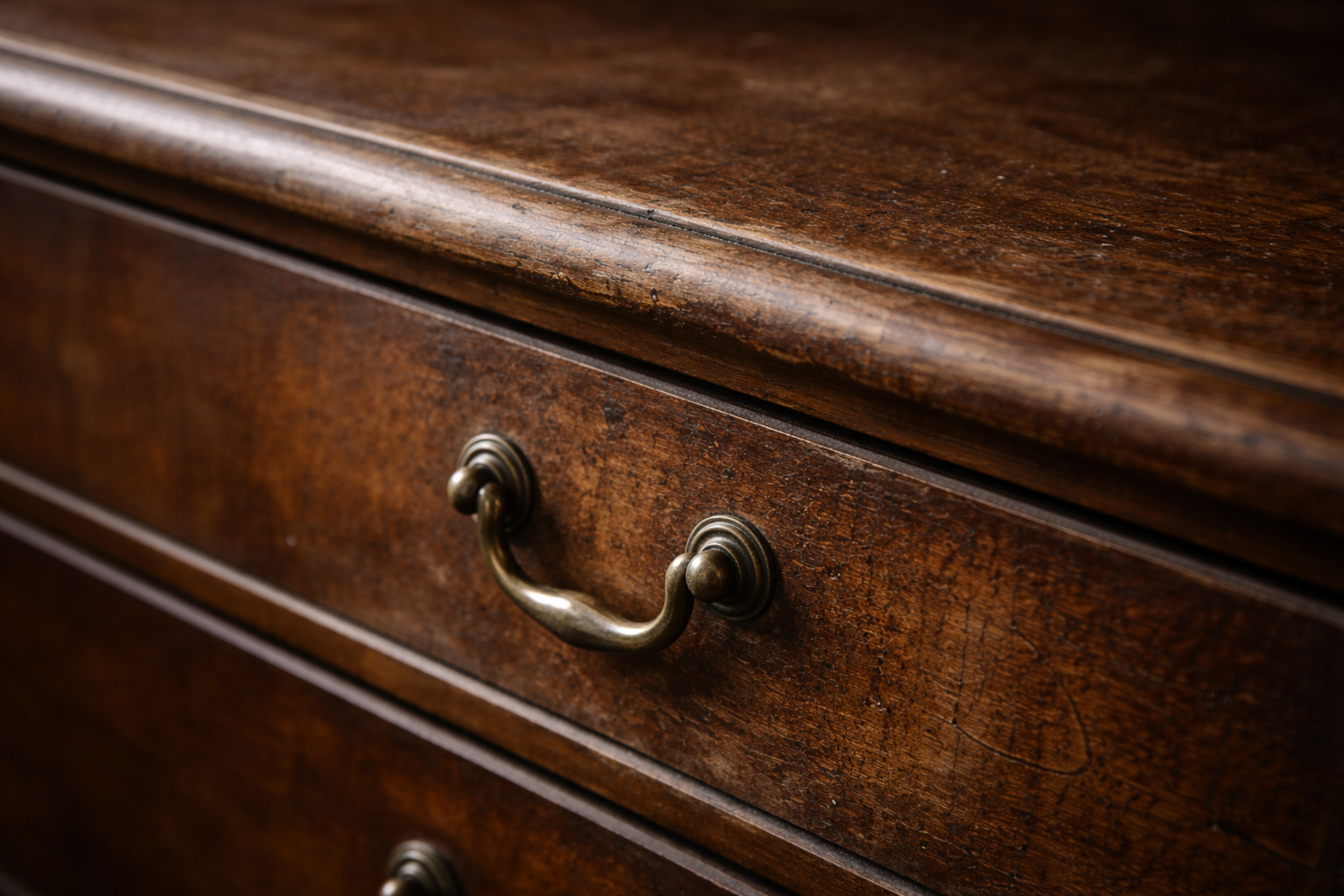
They point to a worn edge.
A softened surface.
A place where the finish has thinned through years of touch.
They ask, “Will you fix this?”
I usually pause before answering.
Because what they are seeing is not damage.
It is evidence.
Wabi-Sabi and the Acceptance of Time
Wabi-sabi is often misunderstood as an aesthetic.
In practice, it is a way of seeing.
It asks us to accept that all things are shaped by time.
That nothing remains unchanged.
That usefulness leaves marks.
Patina is not applied.
It is earned.
It forms slowly, without intention, as an object is used and returned to again and again. In that way, patina is not a flaw—it is proof of relationship.
Wear as a Record of Living
Every piece of furniture that has lived a long life carries a record of that life on its surface.
Hands polish wood more honestly than any finish ever could.
Sunlight fades paint patiently.
Edges soften where bodies move and habits repeat.
These marks are not random.
They appear where life gathered.
To erase them entirely is to erase evidence that the piece was useful, familiar, and present in someone’s daily life.
The Difference Between Damage and Imperfection
Wabi-sabi makes a clear distinction between imperfection and failure.
Damage interrupts function.
Imperfect surfaces tell a story.
A failing joint must be repaired so the piece can continue.
Rot must be addressed so the structure remains sound.
But a worn drawer front or a faded top does not prevent use.
It simply reflects it.
When restoration treats all signs of age as problems to solve, the result is often a surface that looks newer—but feels less true.
Why I Choose to Preserve Patina
I do not preserve patina out of nostalgia.
I preserve it out of respect.
Wabi-sabi teaches that beauty is found in honesty, not renewal.
That age carries value precisely because it cannot be replicated.
When I restore a piece, my role is not to return it to an imagined moment of youth.
It is to stabilize it where it stands—midway through its life.
That often means choosing restraint:
- Cleaning without erasing
- Stabilizing without correcting
- Protecting surfaces without rewriting them
The work becomes quieter that way.
And more faithful.
Patina as Continuity
Patina allows a piece to remain legible.
You can see where someone stood.
Where they reached without thinking.
Where time returned again and again.
The furniture does not pretend to be new.
It does not compete with the present.
It simply continues.
In wabi-sabi thinking, nothing is ever finished—only carried forward.
A restored piece should feel ready, not reset.
Ready to be used again.
Ready to gather new marks without apology.
Evidence Worth Keeping
Patina is not something to overcome.
It is something to listen to.
It tells me where intervention is necessary and where restraint is the greater act of care.
It reminds me that my role is temporary.
And it ensures that when the piece moves forward, it does so without forgetting where it has been.
That is why I leave it.
—
Vu
Wabi Roots